|
|
| |
| 홈 > 기술현황 > 경화형 Paste >PCB-STH |
 |
PCB-STH |
|
| |
| |
| |
| 클릭하시면 해당사항으로
이동합니다. |
|
| |
| Through
Hole Process |
| |
| |
 |
Board preparation |
|
| |
Must be removed
the oxidation and contaminations
on Cu laminate by the standard
cleaning process. For example,
it's acceptable of brushing with
a 3 ~ 5% H2SO4 aqueous solution.
Please refer to the “Appendix
#1”. After cleaning, the board
also must be properly dried. The
moisture trapped in the holes
may cause voiding. |
|
| |
|
Print silver
paste |
|
| |
To obtain optimum
results, please print silver paste
at the supplied viscosity as possible.
But if you need a lower viscosity,
you can dilute the paste with
the “IMD STH THINNER” by less
5wt% of the original weight(Refer
to the “Appendix #2”). Also before
the printing process, all of the
process parameters (e.g. squeegee
contact angle, screen emulsion
thickness, squeegee speed and
screen mesh etc.) must be optimized. |
|
| |
|
Dry & Cure silver
paste |
|
| |
Drying condition
varies for each material, oven
configuration, air flow, board
thickness, hole diameter and temperature.
The printed and dried board is
ready for the curing process if
the silver paste is dried enough
to cure without forming voids
or volcanoes. The following page
will describe the recommended
dry and cure temperature profile
of "SC-2100". |
|
| |
|
Cover silver
with solder mask |
|
| |
A final coating
of solder mask is applied to cover
the silver holes to provide protection
from oxidation, physical and chemical
damages. |
|
| |
 |
|
|
| |
| |
| |
|
| Drying
& Curing |
| |
| |
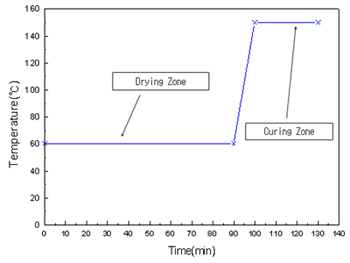
STEP1 : 60℃ X 90min
(STEP2 : 75℃ X 30min)
STEP3 : 150℃ X 30min |
 |
| |
|
|
|
| |
| |
| |
|
| Characteristics
of SC-2100 |
| |
| |
|
Characteristics |
|
| |
1. Good electrical
conductivity
2. Good printability
3. Good Reliability
4. Low silver migration
5. Good adhesion on Cu laminate
6. Good hole shape
7. High hole openness |
|
| |
|
Compositions |
|
| |
1. Silver &
Copper : 55.0 ~ 57.0 wt%(Ag /
Cu = 7 / 3 by wt)
2. Resin : 10.0 ~ 12.0wt%
3. Organic solvents : 25.0 ~27.0
wt%
4. Additives : 3.0 ~ 5.0 wt% |
|
| |
|
Physical properties |
|
| |
1. Viscosity
: 40 ~ 50 poise* (45 ~ 55dPa*s**)
- Brookfield HADV-Ⅱ+,
spindle #52, 5RPM, 25℃
- Rion viscometer, 60rpm,
23℃
2. Thixotropic Index(1/10RPM)
: 2.0 ~ 4.0
3. Pencil hardness : > 4H
4. Specific Gravity : 2.0 ± 0.1
5. Shelf life : 3 months( <
5℃) |
|
| |
|
|
|
| |
| |
| |
|
| SC-2100
Reliability |
| |
| |
|
Reliability |
|
| |
| Items |
Results |
| Initial
Hole Resistance 0.5Φ FR-1
|
<
30mΩ/hole, Pass |
| Solder
Test 260℃,5sec,5cycles |
<
10% variation, pass |
| Boiling
Water Test 100℃,2hrs |
<
20% variation, pass |
| PCT
121℃,95%RH,2atm,8hrs |
<
30% variation, pass |
| Hot
Oil Test 260℃,5sec+25℃,10sec,
100cycles |
<
30% variation, pass |
| Silver
Migration Test 40℃, 95%RH,
50V, 1000hrs |
>
300MΩ, Pass |
|
|
| |
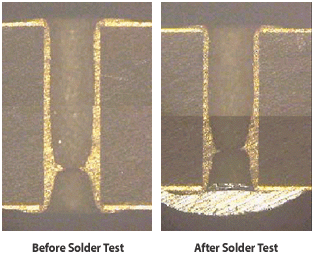
|
Hole shape |
|
|
| |
|
|
|
| |
| |
| |
|
| Application
/ How to store & Use |
| |
| |
|
Screen |
|
| |
1.100~180mesh
with 80~100microns of emulsion
2. Both polyester and stainless
steel screen are applicable
3. Solvent resistant emulsions
must be used |
|
| |
|
Laminates |
|
| |
All STH grade
laminates can be used, but the
less amount of out-gassing of
laminates, the higher quality
is achieved.
[ CEM-3 or FR-4 > CEM-1 >
FR3 > FR1 > FR2 > XPC
]
- CEM : composite epoxy material
- FR : fire retardant
- XPC : paper phenolics |
|
| |
|
Board Density
|
|
| |
| Hole
diameter |
0.6Φ |
0.5Φ |
0.45Φ |
| Pitch |
2.0mm |
1.5mm |
1.3mm |
| Board
Thickness |
1.0
~ 1.6mm |
|
|
| |
|
Storage |
|
| |
To guarantee
optimum quality, we recommend
storing the paste in a refrigerator(<
5℃). The shelf life is 2 months
under 5℃. |
|
| |
|
How to use |
|
| |
Upon removal
from the refrigerator, we recommend
letting the paste reach room temperature
before opening the jar. This will
prevent the paste from condensing
moisture from the air as it warms
up. We recommend a warm-up time
of 3 hours at room temperature
for a 1.0 or 1.5kg jar.And also
the paste must be mixed properly
for 30minuates before printing.
We recommend using a mixer with
a impeller. |
|
| |
|
|
|
| |
| |
| |
|
| Troubleshooting |
| |
| |
|
Board Density
|
|
| |
| Problems |
Solution |
| Poor
fluidity of paste |
-
Optimize the squeegee angle
and pressure
- Adjust paste viscosity
- Check the conditions of
hole drilled |
| Paste
overflowing over the copper
land |
-
Control the temperature
and humidity
- Minimize the deviation
of hole in the screen pattern |
| Voids
or volcanoes |
-
Increase drying time and
temperature
- Use the STH grade laminate |
| Poor
electrical conductivity |
-
Allow less time between
cleaning and printing process
- Increase drying and curing
times and temperatures
- Check cleaning and rinsing
process |
| Poor
adhesion to substrate |
-
Increase cure cycle
- Check cleaning and rinsing
process
- Allow less time between
cleaning and printing process
(In general,
it’s shorter than 30minuates)
|
|
|
| |
|
|
|
| |
| |
| |
|
| Appendix |
| |
| |
| The relation
between Specific gravity(比重) & Concentration
of Sulfuric acid aqueous solution(硫酸濃度) |
| 比
重 |
硫
酸 濃 度, % |
| 1.0000 |
0.00 |
| 1.0069 |
1.02 |
| 1.0140 |
2.08 |
| 1.0211 |
3.13 |
| 1.0284 |
4.21
|
| 1.0357 |
5.28 |
| 1.0432 |
6.37 |
| 1.0507 |
7.45 |
1.0584
|
8.55 |
| 1.0662 |
9.66 |
| 1.0741 |
10.77 |
|
| |
| ※ In
general, 3 – 5% H2SO4 aqueous solution
is applied as a cleaner for removing
the oxidation layer and some organic
contaminations from the Cu laminate. |
| |
|
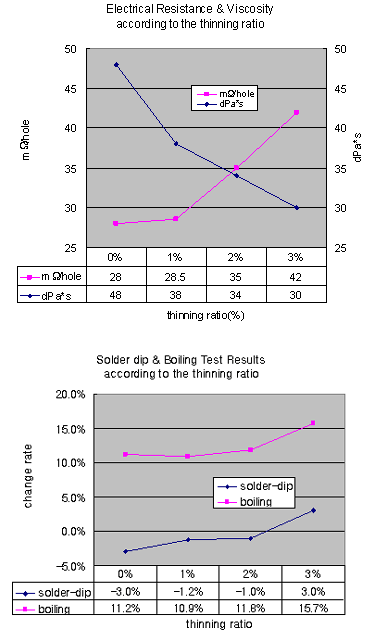
Recommendable
Viscosity For Printing : 30 ~
40 dPa*s |
|
|
|
 |
|
|
|
|
| |
|